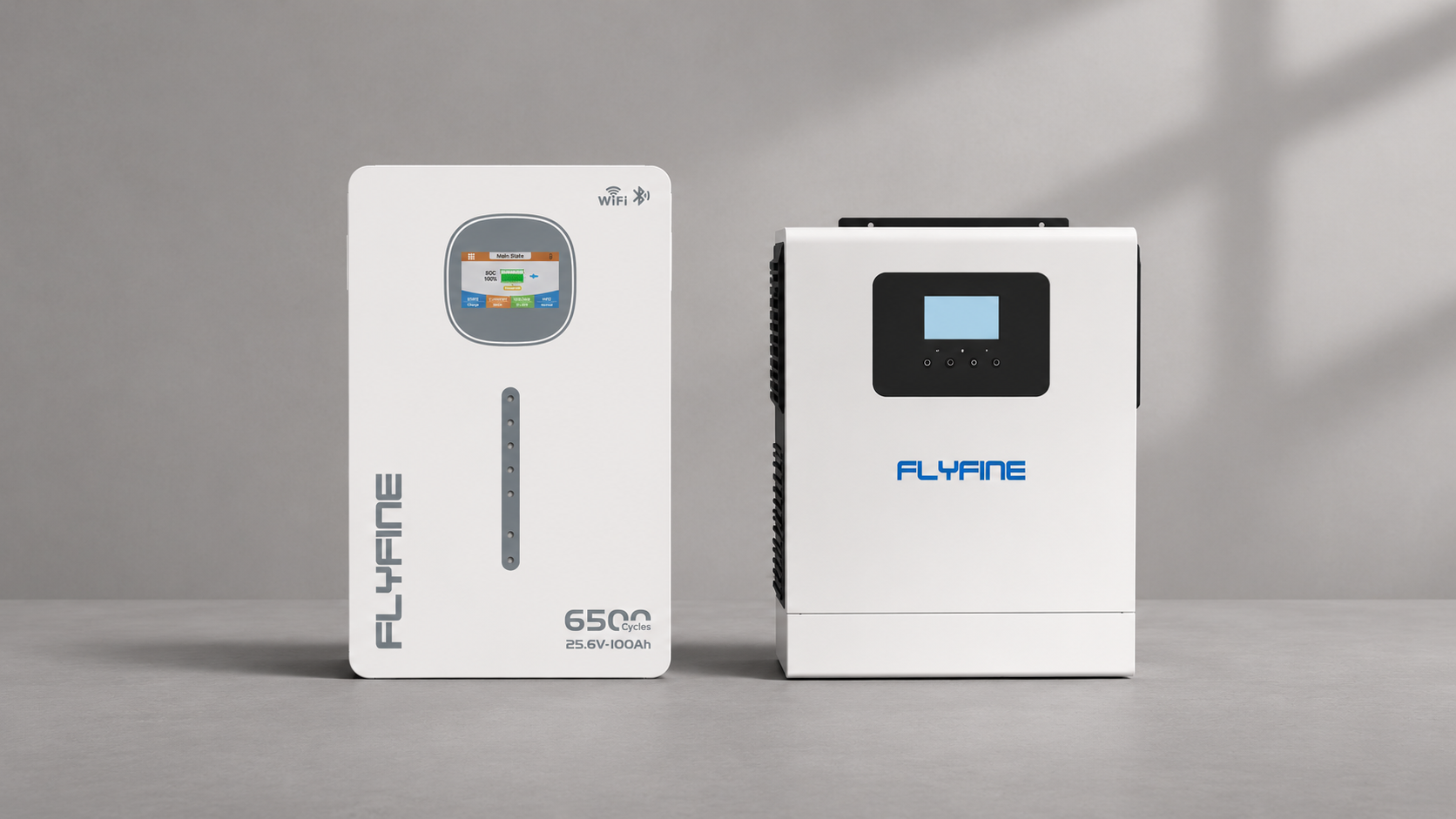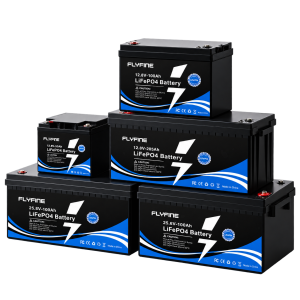


A 24V 100Ah LiFePO4 battery and a 3kW inverter may both be described as “24V” products. However, a shared voltage class does not establish whether the battery can supply enough current for the inverter’s full output.
For distributors, installers and system integrators, the practical question is: what load must the battery support, for how long, and within which operating limits? The answer requires checking energy capacity, battery voltage, discharge current, BMS limits and inverter requirements.
Short answer: One compatible 24V 100Ah battery may operate a 3kW inverter at suitable loads. It should not be assumed to support a continuous 3kW AC load without checking its permitted discharge current.
In the illustrative calculation below, a 3kW AC load requires approximately 130A at 25.6V and an assumed 90% inverter efficiency. That exceeds the FW24100 manual’s listed maximum discharge current of 1C at 25°C, equivalent to 100A for a 100Ah battery.
Product reference: FLYFINE 25.6V 100Ah battery user manual, technical specifications . The current calculation is an estimate, not a product test result.
1. What Does a 24V 100Ah Battery Store?
A 24V-class LiFePO4 battery commonly has a nominal voltage of 25.6V. To estimate nominal stored energy, multiply the nominal voltage by the rated capacity:
The result is 2.56kWh of nominal energy. It describes stored energy, while the battery’s discharge current rating describes a separate limit on how much current it can supply.
The FLYFINE FW24100 product page lists a nominal voltage of 25.6V, a nominal capacity of 100Ah and rated energy of 2.56kWh. The page lists the maximum charge/discharge current as 100A; operating conditions and the final product configuration must also be checked.
Sources: FW24100 product specifications and FW24100 user manual .
2. Why 100Ah Does Not Mean 100A
Ampere-hours and amps are related but describe different things:
- 100Ah: the battery’s nominal capacity.
- Discharge current in amps: the current the battery is permitted to deliver under specified conditions.
- Energy in kWh: an expression of stored energy based on nominal voltage and capacity.
Two 25.6V 100Ah batteries can have similar nominal energy but different BMS settings and current limits. Always use the specification for the exact battery version rather than inferring its discharge capability from the 100Ah label.
3. How Much Current Does a 3kW Load Require?
A first estimate can be made by dividing the AC load by the battery voltage and an assumed inverter efficiency:
Example A: At 25.6V
Assume a constant 3,000W AC load, a battery voltage of 25.6V and an inverter efficiency of 90%:
Under those assumptions, the battery must supply approximately 130A. That is above the FW24100 manual’s stated 100A maximum discharge value at 25°C.
Example B: At 21.6V
Battery voltage changes during discharge. Using 21.6V as a lower-voltage calculation point, while keeping the same assumed load and efficiency:
The FW24100 documentation lists a discharge voltage range of 21.6–28.8V. The example shows why checking only the current at nominal voltage can understate the current needed at a lower voltage.
Source for battery voltage and discharge data: FLYFINE FW24100 user manual .
4. A 3kW Inverter Does Not Always Supply a 3kW Load
The inverter’s rating is its specified output capability. Battery current depends on the load actually being supplied. A 500W load and a 3,000W load therefore place very different demands on the battery.
The following estimates use a constant 25.6V battery voltage and an assumed 90% inverter efficiency. They exclude additional DC cable losses and inverter idle consumption.
← Swipe to view the full table →
| AC load | Estimated battery current | Selection consideration |
|---|---|---|
| 500W | Approximately 22A | Check required runtime and inverter consumption. |
| 1,000W | Approximately 43A | Check battery limits across the expected operating range. |
| 2,000W | Approximately 87A | Check margin for lower voltage and additional losses. |
| 3,000W | Approximately 130A | Exceeds the FW24100’s listed 100A maximum at 25°C. |
These are steady-load estimates, not measured values. Loads with motors or compressors may also have starting demands. Confirm the appliance’s starting requirements, inverter surge rating and battery peak-current limit and duration.
5. How Long Could a 24V 100Ah Battery Run?
Runtime depends on the initial state of charge, allowed depth of discharge, load profile and system losses. For an illustrative calculation:
Assume a 2.56kWh battery, a 90% usable fraction and 90% inverter efficiency:
On that simplified basis, a constant 500W AC load would run for approximately 4.1 hours, while a constant 1,000W load would run for approximately 2.1 hours.
The FW24100 manual lists a depth of discharge value of 0.9. Actual usable energy and runtime depend on the approved system settings and operating conditions.
6. Would Two 100Ah Batteries Be Enough?
Two 25.6V 100Ah batteries have a combined nominal energy of 5.12kWh when connected in an approved parallel configuration. Parallel operation may also increase the available discharge capability, but the permitted current for the complete bank must be confirmed.
Before recommending two batteries, ask the battery supplier and installer to verify:
- Whether the proposed battery models and quantities are approved for parallel use.
- The permitted continuous and peak current of the complete battery bank.
- Current sharing, battery age and state-of-charge requirements.
- BMS addressing, firmware, cables and communication compatibility.
- Inverter battery voltage range and charge/discharge settings.
- Suitable protection devices, cable selection and installation requirements.
The FW24100 manual includes a parallel connection illustration. It does not replace confirmation of the complete system configuration for a particular inverter and installation.
Source: FW24100 user manual, connecting signal line section .
7. What About a 24V 200Ah Battery?
The FLYFINE wall-mounted series also includes the FW24200, listed at 25.6V, 200Ah and 5.12kWh. Its product page lists a maximum charge/discharge current of 200A.
That higher listed current limit can be relevant when evaluating a 3kW load. It is not, by itself, proof that a particular battery and inverter are compatible. Confirm the continuous current under the project’s conditions, voltage limits, BMS communication, charging settings and load profile.
Source: FLYFINE FW24100 / FW24200 product specifications . The linked user manual on that page is identified for the 100Ah model; request model-specific installation documentation for the 200Ah model.
8. Practical Checklist for Buyers and Installers
Include these details when requesting a battery and inverter quotation:
- Inverter model: exact model, battery voltage range and charging settings.
- Actual simultaneous load: equipment and expected total power, rather than inverter rating alone.
- Starting loads: motor or compressor requirements, including peak power and duration.
- Backup time: the required operating hours for the selected loads.
- Battery limits: permitted continuous and peak discharge current, duration and temperature conditions.
- Charging: maximum permitted battery charging current and inverter charging settings.
- BMS communication: required interface, protocol, cable definition and supported firmware.
- Parallel configuration: approved battery count, current sharing and system protection.
For a broader discussion, see our guide to matching LiFePO4 batteries with hybrid inverters .
Frequently Asked Questions
Can one 24V 100Ah battery run a 3kW inverter?
It may operate a compatible inverter at loads within the battery’s approved voltage and current limits. A full 3kW AC load requires a separate current calculation and verification of the battery and BMS limits.
Does a 3kW inverter need a 3kWh battery?
Not necessarily. Kilowatts describe power; kilowatt-hours describe energy. Battery capacity depends on the actual load and required runtime. Discharge-current capability must be checked separately.
Can I connect a 48V battery to a 24V inverter?
Select a battery only within the inverter manufacturer’s specified battery voltage range. A 48V-class battery should not be assumed compatible with a 24V inverter.
Is CAN or RS485 enough to confirm compatibility?
No. The physical interface is only one part of compatibility. Protocol, connector pin assignment, cable, firmware and inverter settings may also need to match.
Discuss Your 24V Battery and Inverter Requirements
FLYFINE provides LiFePO4 battery and inverter products for distributors, installers and system integrators. Share the exact inverter model, load profile, required backup time and proposed battery configuration for a product review.
Explore the 24V wall-mounted battery series and the 24V off-grid inverter series . Product compatibility and final configuration require confirmation for each project.
Contact FLYFINE