

Choosing between a 12V and 24V LiFePO4 battery pack is not simply a matter of selecting a higher voltage. For distributors, equipment manufacturers, solar installers and B2B buyers, the right choice depends on equipment compatibility, power demand, battery capacity, charging requirements and installation conditions.
Both 12.8V and 25.6V lithium iron phosphate batteries are used in DC power and energy storage applications. However, their electrical characteristics can influence system current, cable requirements and available power.
This guide explains the key differences between 12V and 24V LiFePO4 batteries, compares real FLYFINE product specifications, and outlines what buyers should check before placing a bulk order.
Quick answer: Choose a 12V-class LiFePO4 battery when your equipment is designed for 12V DC and the battery's current rating meets the load. Consider a 24V-class battery for compatible higher-power systems where lower operating current may simplify electrical design. Neither voltage is universally better.
1. Understanding 12V and 24V LiFePO4 Battery Packs
A lithium iron phosphate (LiFePO4) cell typically has a nominal voltage of approximately 3.2V. Battery cells can be connected in series to obtain a higher nominal pack voltage.
A typical 12V-class LiFePO4 battery uses four cells in series (4S), producing a nominal voltage of 12.8V.
A typical 24V-class LiFePO4 battery uses eight cells in series (8S), producing a nominal voltage of 25.6V.
| Parameter | 12V-Class Battery | 24V-Class Battery |
|---|---|---|
| Typical nominal voltage | 12.8V | 25.6V |
| Typical cell arrangement | 4S | 8S |
| Nominal energy at 100Ah | 1.28kWh | 2.56kWh |
| Current for a theoretical 1kW DC load | Approximately 78.1A | Approximately 39.1A |
| Charger requirement | 12V-class LiFePO4-compatible | 24V-class LiFePO4-compatible |
| Equipment requirement | Compatible 12V DC input | Compatible 24V DC input |
Scroll horizontally to view the complete comparison on smaller screens.
These nominal values are useful for preliminary system comparison. Actual operating voltage, charging limits and current capability vary by battery model.
A 24V-class LiFePO4 battery should not be connected directly to equipment rated only for 12V input.
2. Why Does System Voltage Matter?
Higher Voltage Can Reduce Current at the Same Power
For a given electrical power requirement, a higher DC voltage generally allows the same power to be delivered at a lower current.
Basic DC power relationship:
Power (W) = Voltage (V) × Current (A)
For an illustrative 1,000W DC load:
12.8V system:
1,000W ÷ 12.8V = approximately 78.1A
25.6V system:
1,000W ÷ 25.6V = approximately 39.1A
In this simplified example, doubling the nominal voltage reduces current by approximately 50%.
Lower current may help reduce resistive losses and influence cable and protection equipment selection. For the same conductor resistance, resistive loss is proportional to the square of current.
However, this does not mean that a 24V battery automatically requires a smaller cable or provides higher overall efficiency. Cable length, permissible voltage drop, temperature, conductor installation, protection devices and applicable electrical requirements must still be evaluated.
Actual battery current also changes with operating voltage and connected equipment efficiency.
Higher Voltage Does Not Automatically Mean More Energy
A common purchasing mistake is comparing batteries using only ampere-hour capacity.
For example, a 12.8V 200Ah battery and a 25.6V 100Ah battery both have a theoretical nominal energy of 2.56kWh.
Although their voltage and Ah ratings differ, their nominal stored energy is the same.
The relevant calculation is:
Nominal Energy (Wh) = Nominal Voltage (V) × Capacity (Ah)
12.8V × 200Ah = 2,560Wh
25.6V × 100Ah = 2,560Wh
Buyers should compare batteries using both Wh/kWh and their electrical operating limits, rather than Ah alone.
Usable energy depends on the permitted discharge range, battery temperature, load profile, aging and system losses.
3. Comparing FLYFINE 12.8V and 25.6V LiFePO4 Batteries
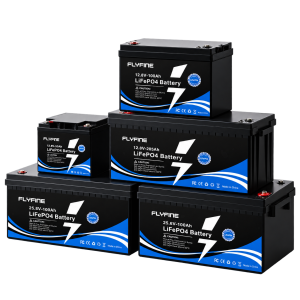
FLYFINE offers a 12.8V / 25.6V LiFePO4 battery series covering five voltage and capacity combinations.
The following table summarizes selected specifications from FLYFINE's published product data.
| Battery Configuration | Rated Energy | Max. Continuous Discharge | Approx. Weight |
|---|---|---|---|
| 12.8V 50Ah | 640Wh | 50A | 7.1kg |
| 12.8V 100Ah | 1.28kWh | 100A | 10.78kg |
| 12.8V 205Ah | 2.624kWh | 200A | 20.6kg |
| 25.6V 100Ah | 2.56kWh | 100A | 19.15kg |
| 25.6V 205Ah | 5.248kWh | 200A | 40.13kg |
Source: FLYFINE 12.8V / 25.6V Battery Series product specifications.
The series includes IP54 enclosure protection, M8 terminals and optional Bluetooth monitoring, according to the published datasheet.
The important distinction is that rated capacity, discharge current and weight are model-specific. Buyers should not assume that every 12V or 24V battery offers the same performance.
For example, the FLYFINE 12.8V 205Ah model provides 2.624kWh of rated energy, while the 25.6V 100Ah model provides 2.56kWh. Their nominal energy values are close, but their voltage, maximum continuous discharge ratings and integration requirements differ.
Review the complete FLYFINE 12.8V / 25.6V LiFePO4 Battery Series for individual model specifications and product documentation.
4. Which Applications Are Better Suited to 12V or 24V Batteries?
The correct battery voltage should normally follow the electrical requirements of the connected equipment, rather than a general preference for a higher voltage.
12V-Class Power Equipment
12.8V LiFePO4 batteries may be considered for compatible 12V DC appliances, small backup systems, selected mobile power equipment and other lower-voltage applications.
24V-Class DC Equipment
25.6V LiFePO4 batteries may suit compatible 24V DC loads, control equipment, mobile power systems and higher-power applications where reducing current is beneficial.
Small Solar Battery Systems
Both voltage classes can support appropriately designed solar battery systems. The selected charge controller and inverter must support the battery's operating voltage and charging profile.
OEM Equipment Integration
Equipment manufacturers may select a voltage class based on DC bus architecture, peak current demand, enclosure space, charging equipment and required battery management functions.
These examples indicate potential applications, not universal compatibility approvals. The final battery must be matched to the exact host equipment.
5. How to Choose the Right Battery Capacity
After identifying the correct voltage class, the next step is to determine the required battery energy and power.
For a preliminary backup-power estimate:
Required delivered energy (Wh) = Load power (W) × Operating time (hours)
Illustrative example:
A 500W load operating for four hours requires:
500W × 4 hours = 2,000Wh
The example represents energy delivered to the load, not necessarily the battery's required nominal capacity.
The final battery sizing must allow for the permitted depth of discharge, conversion losses, temperature, aging and any required energy reserve.
A 25.6V 100Ah battery provides 2.56kWh of nominal energy, but the actual available runtime must be verified for the specific application.
Power demand must also be checked separately from energy capacity. A battery with sufficient kWh may still be unsuitable if the load exceeds its continuous or peak discharge current limits.
6. BMS, Charging and Electrical Compatibility
Battery voltage and capacity are only part of the purchasing decision. For OEM projects and bulk orders, buyers should confirm the BMS and charging requirements before selecting a product.
Battery Management System
The BMS should provide the protection functions required by the battery design, including appropriate monitoring of cell voltage, current and temperature.
Relevant purchasing questions include:
- What is the maximum continuous discharge current?
- What peak-current conditions are supported?
- What are the charge and discharge temperature limits?
- How are protection faults indicated and reset?
- Is battery monitoring required?
- Are communication functions included or optional?
Charging Requirements
12.8V and 25.6V LiFePO4 batteries require charging equipment with voltage and current settings appropriate to their respective battery configurations.
For example, FLYFINE's 12.8V / 25.6V battery series lists maximum charging voltages of 14.6V and 29.2V respectively. These are model-series specifications, not universal settings for every LiFePO4 battery on the market.
Buyers must verify the specific charging voltage, current limit and permitted charging temperature for the selected model.
Important: Do not assume that a charger designed for lead-acid batteries is automatically suitable for LiFePO4 batteries. Compatibility depends on the charging profile, voltage settings and protection behavior.
Series and Parallel Connections
Some battery models support series or parallel connection, but the allowable quantity and wiring configuration depend on the battery and its BMS design.
FLYFINE's 12.8V / 25.6V battery series lists up to four batteries in series or up to four in parallel, subject to an approved configuration.
This does not mean every mixed series-parallel arrangement is automatically permitted.
Before connecting multiple batteries, confirm the model combination, battery state, electrical protection, cable requirements and manufacturer-approved configuration.
7. What Should B2B Buyers Check Before Ordering?
For distributors and equipment manufacturers, product selection should consider technical compatibility, quality consistency and purchasing requirements.
| Purchasing Item | Information to Confirm |
|---|---|
| Application | Equipment type, DC system voltage and operating conditions |
| Voltage | Nominal voltage and acceptable input range |
| Capacity | Required Ah, Wh/kWh and backup duration |
| Discharge | Continuous current, peak current and peak duration |
| Charging | Charger voltage, current and charging profile |
| BMS | Protection functions, monitoring and communication needs |
| Enclosure | Dimensions, material, terminals and IP requirements |
| Documentation | Datasheet, transport documents and applicable compliance evidence |
| Commercial | Order quantity, destination market, packaging and delivery requirements |
A complete technical requirement helps buyers compare quotations based on equivalent specifications instead of comparing nominal Ah or price alone.
For projects requiring non-standard battery dimensions, connectors, communication functions or branding, review FLYFINE OEM/ODM Battery Solutions.
8. Explore More FLYFINE LiFePO4 Battery Options
In addition to the 12.8V / 25.6V battery series, FLYFINE offers different 12V-class enclosure and capacity options.
12.8V ABS Case LiFePO4 Batteries
The ABS case series includes 100Ah, 200Ah and 300Ah configurations, with IP65 protection listed for the product series.
Explore FLYFINE 12.8V ABS Case Batteries .
12.8V Metal Case LiFePO4 Batteries
The metal case series includes 100Ah, 150Ah, 205Ah, 300Ah and 314Ah capacity options.
Enclosure construction, current ratings and physical dimensions should be compared for each model.
Explore FLYFINE 12.8V Metal Case Batteries .
Different FLYFINE product series have different specifications. Do not assume that IP ratings, current limits or optional features are identical across these ranges.
Frequently Asked Questions
Is a 24V LiFePO4 battery better than a 12V battery?
Not necessarily. A 24V-class battery can reduce current for the same power, but it must be compatible with the equipment. A 12V-class battery may be more suitable for equipment designed around a 12V DC supply.
Does a 24V 100Ah battery store more energy than a 12V 100Ah battery?
Yes, when comparing typical 25.6V and 12.8V nominal LiFePO4 configurations. At 100Ah, a 25.6V battery provides 2.56kWh of nominal energy, while a 12.8V battery provides 1.28kWh.
Can I replace a 12V battery with a 24V LiFePO4 battery?
Not without confirming compatibility. The connected equipment, charger, inverter and electrical protection must support the proposed voltage. A 24V-class battery should not be connected directly to equipment designed only for 12V.
Can two 12V LiFePO4 batteries be connected to create a 24V system?
Only if the exact battery models are approved for series connection and the installation follows the manufacturer's requirements. Check BMS compatibility, battery matching, charging and wiring before making any connections.
Which is more important for battery selection, Ah or kWh?
Both are useful, but kWh expresses nominal energy and allows a clearer comparison across different voltage classes. Buyers must also check discharge current, usable energy, charging limits and compatibility.
Does FLYFINE offer custom 12V and 24V battery packs?
FLYFINE provides OEM/ODM battery cooperation. Specific voltage, capacity, enclosure, connector and BMS requirements can be submitted for technical review. Final options depend on project feasibility and the agreed specifications.
Conclusion: Choosing the Right Battery for Your Project
The choice between 12V and 24V LiFePO4 battery packs should start with the connected equipment and required power, not battery capacity alone.
For compatible low-voltage DC equipment, 12.8V batteries may provide a straightforward solution. For compatible higher-power applications, 25.6V batteries may offer benefits through lower operating current.
For B2B procurement, buyers should compare nominal energy, continuous and peak current, BMS functions, charger compatibility and installation requirements.
FLYFINE offers 12.8V and 25.6V LiFePO4 battery options, alongside OEM/ODM cooperation for project-specific requirements.
Find the Right LiFePO4 Battery Pack for Your Business
Looking for 12V or 24V LiFePO4 batteries for distribution, equipment integration or an OEM project?
Share your application, preferred voltage, required capacity, current demand, expected order quantity and destination market with FLYFINE.
Our team can discuss suitable product configurations and the next steps for technical evaluation and quotation.
Request a Battery Pack QuoteProduct References
- FLYFINE 12.8V / 25.6V LiFePO4 Battery Series
- FLYFINE 12.8V ABS Case LiFePO4 Battery
- FLYFINE 12.8V Metal Case LiFePO4 Battery
Product information is based on FLYFINE's published specifications. Illustrative electrical calculations are for preliminary comparison only. Final product selection, electrical design and installation should follow the applicable datasheet, equipment requirements and relevant safety standards.