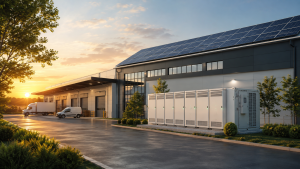
Commercial & Industrial Energy Storage
C&I ESS Project Cases: How to Choose the Right Energy Storage System
Choosing a commercial and industrial energy storage system is not only about battery capacity. A reliable C&I ESS must match the project’s load profile, installation environment, PV capacity, PCS or inverter power, cooling method, safety requirements, and future expansion plan.
For factories, EV charging stations, industrial parks, commercial buildings, and weak-grid sites, a well-designed C&I ESS can help reduce peak demand, improve solar self-consumption, stabilize power supply, and support future load growth.
Based on FLYFINE’s real C&I ESS project cases, this article explains how different system architectures are used in practical applications, including high-voltage LiFePO4 rack batteries, outdoor cabinet ESS, air-cooled systems, liquid-cooled ESS, containerized BESS, and PV storage EV charging solutions.
For customers planning a commercial or industrial storage project, FLYFINE’s Commercial & Industrial ESS Solution page is a good starting point for system selection.
What Makes a C&I ESS Different From a Residential ESS?
A residential energy storage system is mainly designed for household solar storage, home backup power, and daily self-consumption. A C&I ESS is different. It often requires higher voltage, larger capacity, stronger system integration, PCS or hybrid inverter matching, outdoor protection, and more advanced safety design.
A commercial and industrial ESS is commonly used for:
- Peak shaving and demand charge reduction
- Factory and commercial building backup power
- Solar PV self-consumption
- EV charging station energy support
- Industrial park energy management
- Weak-grid or off-grid operation
- Diesel generator optimization
- MWh-level battery energy storage projects
This is why the system structure matters. A rack battery, an outdoor cabinet ESS, and a containerized BESS may all use LiFePO4 battery technology, but they are designed for different project scales and operating conditions.
1. High-Voltage LiFePO4 Rack Battery Systems for Flexible C&I Projects
High-voltage LiFePO4 rack battery systems are suitable for commercial and industrial projects that require modular design, flexible capacity, and easier maintenance access.
In FLYFINE’s 3U high-voltage rack battery cases, one large configuration uses a 665.6V 399kWh battery system with a 500kW hybrid solar inverter. The system is built with 5.12kWh battery packs, 13 packs per cluster, and 6 clusters connected in parallel.
Other project configurations include 665.6V 66kWh with a 30kW hybrid solar inverter, 307.2V 30kWh with a 15kW hybrid solar inverter, 512V 153kWh with an 80kW hybrid solar inverter, and 307.2V 62kWh with a 30kW hybrid solar inverter.
Rack battery systems are a good choice when the project needs indoor installation, flexible expansion, and compatibility with hybrid solar inverters. They also provide better maintenance access because individual modules and clusters are easier to inspect and service.
For larger commercial rack systems, FLYFINE’s 5U high-voltage rack battery cases include 256V 160kWh with an 80kW hybrid solar inverter, 358.4V 200kWh with a 100kW hybrid solar inverter, 512V 160kWh with an 80kW hybrid solar inverter, and 832V 261kWh with a 150kW hybrid solar inverter.
2. Outdoor Cabinet ESS for Faster Commercial Deployment
For many commercial sites, building a dedicated battery room is not practical. In this case, outdoor cabinet ESS becomes a better option.
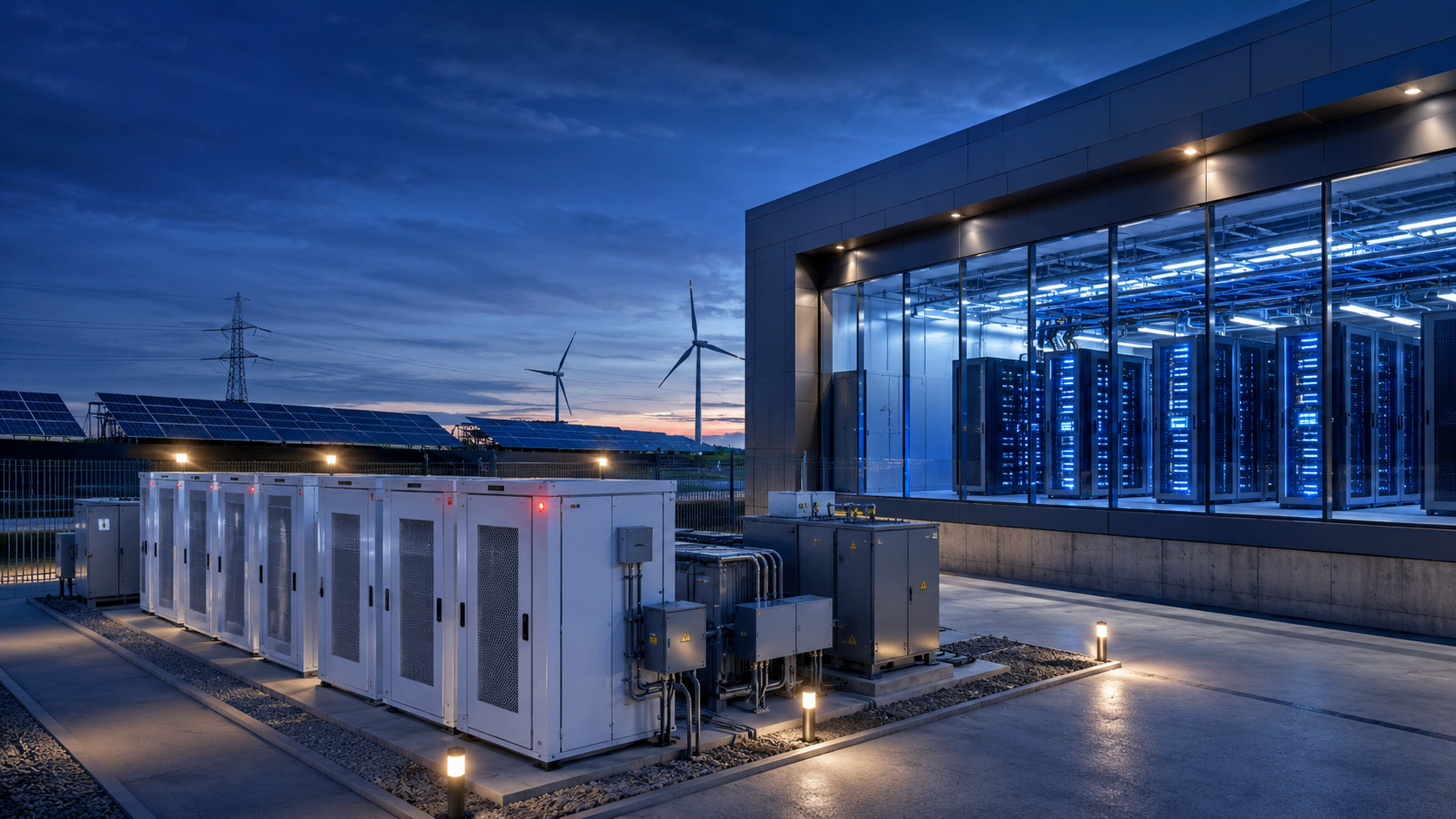
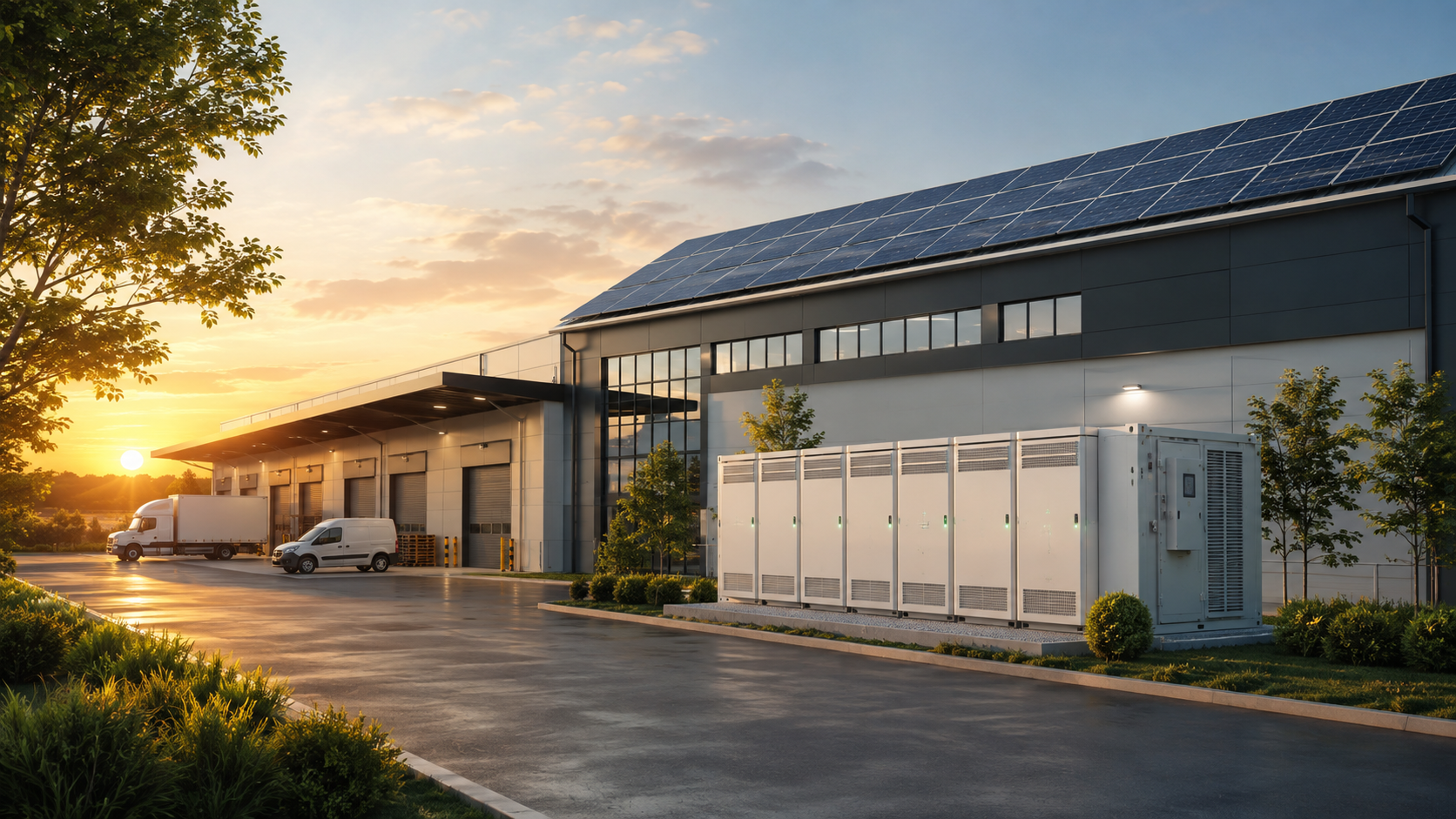
An outdoor cabinet ESS integrates battery packs, high-voltage control, PCS, cabinet protection, fire suppression, air conditioning, and accessories into one protected system. This reduces on-site installation complexity and makes the system suitable for factories, charging stations, commercial buildings, and outdoor solar storage projects.
FLYFINE’s air-cooled outdoor cabinet cases include 107kWh / 120kWh systems with 50kW PCS, 128kWh / 160kWh systems with 50kW or 80kW PCS, 180kWh with 100kW PCS, 160kWh / 200kWh with 80kW or 100kW PCS, 192kWh / 241kWh with 100kW PCS, 208kWh / 261kWh with 50kW or 80kW PCS, and 301kWh with 150kW PCS.
For cabinet-level applications, FLYFINE offers related solutions such as the 261kWh All In One Microgrid ESS and the 241kWh Battery Cluster ESS.
This expansion capability is important because many commercial sites do not want to oversize the system at the beginning. They may start with one cabinet and add more capacity later as the business grows or electricity demand increases.
3. Liquid-Cooled ESS for High-Demand Industrial Applications
As system capacity increases, thermal management becomes more important. Air-cooled ESS can meet many standard C&I applications, but high-demand projects may require liquid-cooled ESS for better temperature consistency and long-term operating stability.
Battery systems that operate frequently or discharge at high power generate heat. If temperature differences between battery modules become too large, the system may face reduced efficiency, uneven aging, or higher maintenance pressure.
FLYFINE’s liquid-cooled ESS project cases include 241kWh / 261kWh / 482kWh, 783kWh / 1566kWh, and 1044kWh configurations. One customer feedback case shows a liquid-cooled battery storage system configured as 215kWh × 5 clusters = 1075kWh.
Liquid-cooled ESS is more suitable for:
- High-power EV charging stations
- Large industrial energy storage systems
- Frequent charge and discharge operation
- High-density outdoor ESS cabinets
- Large PV storage projects
- Sites requiring stronger temperature control
The decision between air cooling and liquid cooling should be based on duty cycle, ambient temperature, discharge power, operating hours, and long-term maintenance needs.
4. Containerized BESS for MWh-Level Projects
When the required capacity reaches MWh level, containerized BESS becomes the more practical system architecture.
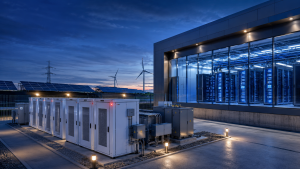
A containerized battery energy storage system is suitable for large industrial parks, utility-scale projects, renewable energy plants, microgrids, and high-capacity backup power applications.
FLYFINE’s project materials include containerized air-cooled BESS configurations such as 2210kWh / 4421kWh and 2612kWh / 5224kWh. One system uses a 2612kWh container, with two containers connected in parallel to reach 5224kWh. The system includes battery packs, high-voltage control box, PCS, MPPT, STS, container, fire suppression system, air conditioning, and accessories, and was shipped to Switzerland.
For MWh-level applications, FLYFINE’s 1MWh / 2MWh Container Energy Storage System provides a suitable product reference for large commercial and industrial storage projects.
Containerized BESS is not simply a larger battery cabinet. It requires system-level planning, including site layout, grid connection, transportation, installation, commissioning, fire safety, ventilation, thermal control, and long-term operation strategy.
5. PV Storage EV Charging Solutions
PV storage EV charging is one of the most important C&I ESS applications. Charging stations can create high peak loads, especially when multiple vehicles charge at the same time. Without battery storage, the site may face higher grid demand, transformer capacity limits, or expensive grid upgrades.
A PV+BESS+Charging solution combines solar PV, battery energy storage, and EV charging piles. Solar PV can supply daytime loads, ESS can support charging demand when load increases, and EMS can optimize charge and discharge according to electricity price changes.
Huizhou, Guangdong
360kW charging pile capacity, 16 charging terminals, 230kWp PV, and 300kW / 645kWh ESS.
Shenzhen, Guangdong
720kW charging pile capacity, 12 charging terminals, 700kWp PV, and 375kW / 723kWh ESS.
Azerbaijan
120kW charging pile capacity, 4 charging terminals, 264kWp PV, and 100kW / 233kWh ESS.
Ganzhou, Jiangxi
240kW charging pile capacity, 24 charging terminals, 98kWp PV, and 220kW / 455kWh ESS.
These cases show how PV, battery storage, and charging infrastructure can work together to reduce peak demand and support more stable charging operations.
6. Heavy-Duty Truck Charging Requires Stronger ESS Support
Heavy-duty truck charging is different from passenger EV charging. It can create higher and more concentrated demand within a shorter period.
In Wuzhou City, Guangxi Province, one project includes 240kW charging pile capacity for heavy-duty trucks, 4 charging terminals, 100kWp installed PV capacity, and 200kW / 2110kWh energy storage capacity.
This case shows why ESS is not only for backup. In charging infrastructure, battery storage works as a power buffer between PV, grid, and charging loads.
How to Choose the Right C&I ESS
The best C&I ESS is not always the largest battery. It is the system that matches the site’s real power demand and operating conditions.
Application Goal
Peak shaving, backup power, PV self-consumption, EV charging support, or microgrid operation.
Installation Environment
Indoor rack systems, outdoor cabinet ESS, or containerized BESS depending on site conditions.
Power Conversion
Hybrid solar inverter or PCS selection must match battery voltage, PV input, load demand, and grid connection.
Cooling Method
Air-cooled ESS fits standard applications; liquid-cooled ESS fits high-power or high-frequency operation.
Expansion Plan
Future capacity growth should be planned through racks, cabinets, or containerized parallel systems.
Customization
FLYFINE provides OEM/ODM custom services and project selection support for different energy storage applications.
FAQ: C&I ESS Project Cases
What is a C&I ESS?
−A C&I ESS is a commercial and industrial energy storage system designed for factories, commercial buildings, EV charging stations, industrial parks, microgrids, and large backup power applications.
What is the difference between C&I ESS and residential ESS?
+Residential ESS is mainly used for home solar storage and backup power. C&I ESS usually requires larger capacity, higher voltage, PCS or hybrid inverter integration, stronger protection, and more flexible installation methods.
When should I choose a rack battery system?
+Choose a rack battery system when the project needs modular expansion, indoor installation, easier maintenance, and flexible matching with hybrid solar inverters.
When is outdoor cabinet ESS better?
+Outdoor cabinet ESS is better when the project needs integrated outdoor protection, faster deployment, built-in thermal management, and cabinet-level fire protection.
When should I choose liquid-cooled ESS?
+Liquid-cooled ESS is more suitable for high-power, high-frequency, high-capacity, or high-temperature applications where battery temperature consistency is important.
What is containerized BESS used for?
+Containerized BESS is used for MWh-level projects such as industrial parks, large PV plants, microgrids, utility-scale storage, and large backup power systems.
Why do EV charging stations need ESS?
+ESS can store solar or off-peak electricity and discharge during charging peaks, reducing grid pressure and improving charging reliability.
How do I choose the right C&I ESS capacity?
+The right capacity depends on load profile, peak demand, backup duration, PV generation, charging pile demand, grid connection limits, and future expansion plan.
Planning a C&I Energy Storage Project?
Real C&I ESS project cases show that commercial and industrial energy storage is not one fixed product. Rack battery systems, outdoor cabinet ESS, liquid-cooled systems, containerized BESS, and PV+BESS+Charging solutions are designed for different project needs.
Review FLYFINE project cases or contact FLYFINE to discuss your load profile, PV capacity, installation environment, and suitable ESS configuration.