'/%3E%3C/svg%3E)
'/%3E%3Cpath%20fill='%23b2b2b2'%20d='M241%20382q0%2016%2017%2026%2017%2011%2042%2011t42-11q16-11%2017-26V269H241'/%3E%3Cpath%20fill='%239f7e00'%20d='M241%20379q0%2014%208%2023%209%209%2021%209%2014%200%2021-9%209-9%209-23V269h-59'/%3E%3Cpath%20d='M241%20339v-70h59v110q0%2014-9%2023l-6%205v-68h-15v72q-8%200-14-4v-68zm59%2040c0%2022%2015%2032%2029%2032%2021%200%2030-18%2030-32v-40h-59'/%3E%3Cpath%20fill='%239f7e00'%20d='M266%20277v5h2v12h-3v-5h2v-5h-9v5h2v5h-4v9h3v18h-5v10h34v-10h-5v-18h3v-9h-4v-5h2v-5h-9v5h2v5h-3v-12h2v-5zm42%20101q0%2010%206%2017%206%206%2015%207%2010-1%2016-7%206-7%206-17v-29h-43'/%3E%3Ccircle%20fill='%230044ad'%20cx='329.5'%20cy='372'%20r='6'/%3E%3Cellipse%20fill='%230044ad'%20cx='300'%20cy='340'%20rx='16'%20ry='21'/%3E%3C/svg%3E)

For many businesses, electricity is no longer simply a monthly operating expense. Peak demand, grid reliability, solar utilization and future load growth can directly affect operating costs, production schedules and business continuity.
A factory may experience short but expensive power peaks when several machines operate simultaneously. A hotel may need to keep critical services running during an outage. A warehouse may generate solar energy during the day but require more electricity later, while an EV charging site may need more power than the existing grid connection can provide.
In these situations, commercial energy storage systems for businesses provide more than backup power. A properly designed BESS can become part of the site's daily energy management strategy.
What Is a Commercial Energy Storage System?
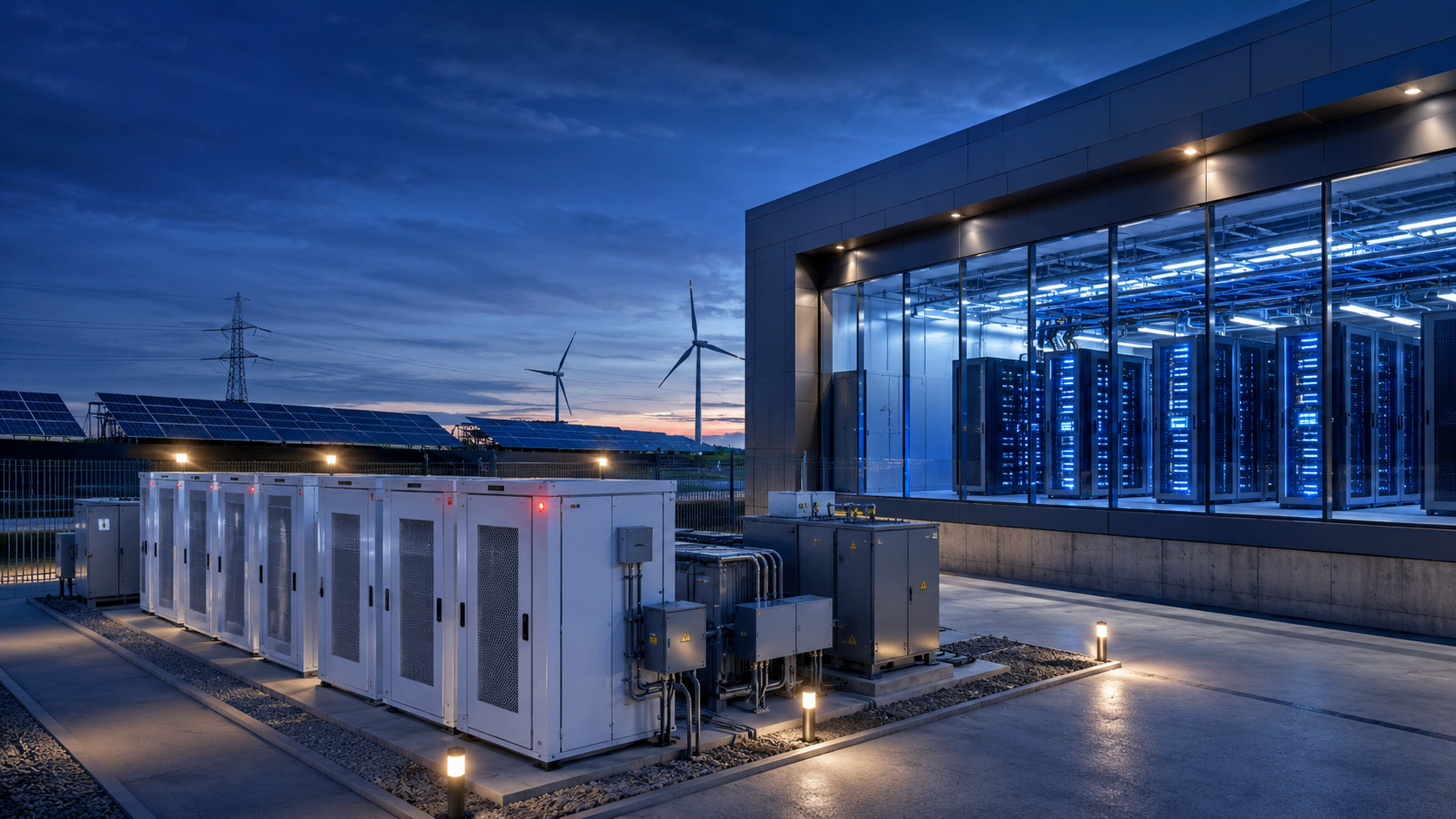
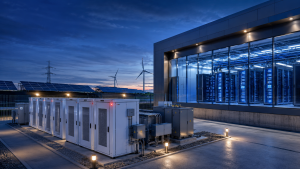
A commercial energy storage system, often referred to as a C&I ESS or commercial BESS, stores electricity and releases it when the business needs additional power or when using stored energy creates greater operational value.
A typical system may include:
- LiFePO4 battery modules or racks;
- battery management system (BMS);
- power conversion system (PCS);
- energy management system (EMS);
- electrical protection and distribution equipment;
- thermal management;
- remote monitoring;
- optional PV, grid, generator and EV charging integration.
Compared with residential battery storage, commercial projects normally involve higher power, larger capacities and more complex operating strategies.
The system therefore needs to be designed around both kW and kWh.
Why Are More Businesses Considering Energy Storage?
There is no single reason for installing a commercial BESS. Different businesses have different priorities, and many projects combine several applications in the same system.
| Business Challenge | How Energy Storage Can Help |
|---|---|
| High peak demand | Discharge during peak periods to reduce grid demand |
| Solar energy not used immediately | Store excess PV generation for later use |
| Grid outages | Support selected critical loads |
| Frequent diesel generator operation | Coordinate batteries, PV and generator through EMS |
| Limited grid connection | Provide temporary additional power for loads such as EV chargers |
| Future expansion | Add energy flexibility without designing only around today's load |
1. Control Peak Demand and Electricity Costs
Commercial and industrial loads are rarely constant. Compressors, production machinery, HVAC systems, pumps, refrigeration equipment and EV chargers may operate simultaneously and create short periods of high demand.
A BESS can discharge during these periods to reduce the power imported from the grid.
Suppose a business normally operates below 450 kW but occasionally reaches 600 kW. If the target is to keep grid demand below 480 kW:
This means the system may need at least 120 kW of discharge power at the highest point.
However, the required battery capacity in kWh depends on how long the load remains above 480 kW.
A 120 kW peak lasting 15 minutes requires far less energy than the same power difference lasting three hours.
2. Increase Solar Self-Consumption
Solar PV can reduce daytime grid consumption, but solar production does not always match the site's demand profile.
A warehouse, hotel or commercial building may generate its highest PV output around midday while its largest electricity demand occurs later in the afternoon or evening.
With solar battery storage for businesses, part of this daytime energy can be stored instead of being immediately exported or curtailed.
A typical operating sequence may look like this:
This can increase the amount of solar electricity consumed directly by the business.
But a larger battery does not automatically mean greater savings. The capacity should be based on realistic excess solar generation and the amount of energy that can actually be shifted to another period.
3. Maintain Critical Loads During Grid Outages
Backup power is another important application of battery storage for business.
The key question is not:
“How much electricity does the entire facility use?”
A better question is:
“Which loads must continue operating when the grid fails?”
Critical loads vary by industry.
| Business Type | Typical Critical Loads |
|---|---|
| Factory | Control systems, selected machinery, IT and safety systems |
| Hotel | Reception, security, refrigeration, essential lighting and selected HVAC |
| Farm | Pumps, ventilation, refrigeration and control systems |
| Warehouse | IT, security, lighting and temperature-sensitive storage |
| Supermarket | Refrigeration, payment systems, lighting and security |
| Office | Servers, communications, access control and essential lighting |
Imagine that a facility normally reaches 500 kW, but only 120 kW of its loads need to operate during a blackout.
If two hours of autonomy are required:
The nominal battery capacity must then be adjusted for usable depth of discharge, conversion efficiency, reserve SOC and degradation.
Separating critical and non-critical loads can therefore prevent unnecessary oversizing.
4. Reduce Diesel Generator Dependence
Diesel generators remain necessary at many commercial and industrial facilities, especially where the grid is weak or outages are frequent.
Energy storage does not necessarily need to replace the generator. In many projects, the battery and generator work together.
The battery can respond quickly to changes in load and provide energy during short-duration events, while the generator remains available when longer periods of energy supply are required.
Depending on the operating strategy, this hybrid architecture can help reduce:
- generator runtime;
- fuel consumption;
- low-load generator operation;
- maintenance requirements;
- noise and local emissions.
For remote businesses, resorts, farms and industrial microgrids, an EMS can coordinate when the generator starts and when the battery charges or discharges.
5. Support EV Charging When Grid Capacity Is Limited
EV charging is introducing a new high-power load to many commercial facilities.
Hotels, shopping centers, warehouses, logistics fleets and charging operators may want to install more charging capacity than the existing grid connection can support.
Consider a business with:
- 300 kW available from the grid;
- 80 kW of existing building load;
- 350 kW of simultaneous EV charging demand.
Total demand becomes:
Compared with the 300 kW grid limit:
A BESS with sufficient PCS power could temporarily provide this 130 kW difference.
The required battery capacity would then depend on how long and how frequently the charging demand exceeds the grid limit.
This is particularly useful for businesses that need to add high-power charging but face expensive or time-consuming grid upgrades.
From Backup Power to Greater Energy Independence
Energy independence does not necessarily mean operating completely without the grid.
For most businesses, a more practical objective is to reduce dependence on a single source of electricity and increase operational flexibility.
A commercial site may combine:
- solar PV for daytime generation;
- battery storage for energy shifting and short-term power support;
- the utility grid for normal electricity supply;
- a generator for long-duration emergency power.
The EMS coordinates these resources according to business priorities.
For example, under normal conditions:
During a grid outage:
If the outage continues and battery SOC becomes too low:
The exact logic depends on the project and the role assigned to each energy source.
Different Businesses Need Different Energy Storage Strategies
Factories and Manufacturing Plants
Manufacturing facilities often combine high peak power with production loads that cannot be interrupted easily.
Typical objectives include:
- peak shaving;
- production continuity;
- solar integration;
- load shifting;
- hybrid operation with generators.
Factories may also have motors, compressors and machinery with high starting power, so PCS sizing is especially important.
Hotels and Resorts
Hotels normally operate around the clock and combine HVAC, lighting, refrigeration, pumps, elevators, kitchens and increasingly EV chargers.
In many hotel projects, the most efficient backup strategy is to prioritize essential services rather than attempting to support every load.
Farms and Agricultural Businesses
Farms may depend on irrigation pumps, cold storage, livestock systems, ventilation and processing equipment.
In areas with strong solar resources or weak grids, PV plus storage can provide an additional level of energy flexibility.
Warehouses and Logistics Centers
Warehouses increasingly combine large rooftop PV systems with refrigeration, material handling and fleet charging.
As fleets become electrified, EV charging can become one of the largest new loads on the site.
Shopping Centers and Supermarkets
HVAC, refrigeration, tenant loads and EV chargers can create overlapping demand peaks.
A commercial BESS can help manage these peaks while maintaining selected critical services when required.
How Do You Size Commercial Battery Storage for a Business?
A useful quotation should not begin with only one question:
“How many kWh do you need?”
A better sizing process evaluates the complete energy profile.
Example: One Business, Multiple Energy Objectives
Consider a commercial facility with:
- 600 kW peak demand;
- 350–450 kW typical operating demand;
- 400 kWp solar PV;
- 150 kW of critical loads;
- occasional grid outages;
- an existing diesel generator;
- planned EV charging expansion.
The business wants to:
- reduce demand above 450 kW;
- increase solar self-consumption;
- maintain critical loads during short outages;
- reduce unnecessary generator operation;
- prepare for additional EV charging.
These requirements do not necessarily require five separate energy systems.
One properly designed C&I ESS may support several operating modes. The important part is how the EMS manages battery capacity between them.
What Determines the Financial Value of a Commercial BESS?
There is no universal payback period for commercial battery storage.
Financial performance depends heavily on local project conditions, including:
- electricity tariff structure;
- demand charges;
- peak and off-peak prices;
- solar production;
- export compensation;
- frequency and duration of outages;
- cost of business downtime;
- generator fuel costs;
- battery cycling strategy;
- system efficiency and degradation.
For a factory, avoiding production interruption may have greater value than electricity arbitrage.
For an EV charging site, being able to deploy chargers before a grid upgrade may be the most important benefit.
For a remote facility, reducing generator runtime may be the primary objective.
The correct financial analysis therefore starts with the business problem, not a generic savings percentage.
Common Mistakes When Selecting Business Energy Storage
Choosing a System Only by kWh
Battery capacity indicates stored energy but does not determine how much instantaneous power can be delivered.
Using Only Monthly Electricity Consumption
Monthly kWh cannot show short demand peaks or the duration of those peaks.
Backing Up Every Load
Separating critical and non-critical loads can significantly reduce the required battery size.
Assuming All PV Energy Can Be Stored
Storage capacity should reflect actual excess solar generation and future load demand.
Ignoring Future Load Growth
New production lines, HVAC equipment and EV chargers may change the load profile substantially.
Comparing Only Initial System Price
Commercial ESS projects should also consider PCS and EMS capability, thermal management, integration, documentation, monitoring, service and expansion capability.
Common Commercial Energy Storage Architectures
Grid + BESS
Common applications include peak shaving, load shifting and backup support.
PV + BESS
This configuration can increase solar self-consumption and shift solar electricity from daytime production into later periods.
PV + BESS + Grid + Diesel Generator
Hybrid systems are suitable for weak-grid sites, remote businesses, frequent-outage environments and commercial microgrids.
Learn more about FLYFINE Commercial Energy Storage Systems .
What Information Should You Provide Before Requesting a Quote?
| Project Information | Why It Matters |
|---|---|
| Country and project location | Grid standards, climate and installation conditions |
| Grid voltage and frequency | PCS and system configuration |
| Maximum load in kW | Power sizing |
| 15-minute load profile | Peak duration and energy analysis |
| Monthly electricity consumption | Overall energy profile |
| Electricity tariff | Cost optimization strategy |
| Solar PV capacity | Solar storage calculation |
| Critical load in kW | Backup system design |
| Required backup time | Battery capacity calculation |
| Existing generator | Hybrid operation strategy |
| EV charging requirements | Future peak demand |
| Available installation space | Cabinet or container configuration |
| Expansion plans | Modular system design |
Build a More Flexible Energy System for Your Business
Commercial energy storage is no longer limited to emergency backup.
A properly designed system can become part of daily business energy management, helping companies:
- control peak demand;
- increase solar self-consumption;
- maintain critical operations;
- reduce generator dependence;
- support EV charging;
- prepare for future load growth;
- increase overall energy flexibility.
The first step is not selecting a battery size. It is understanding how electricity is used throughout the business.
Planning a Commercial Energy Storage Project?
FLYFINE provides commercial and industrial energy storage solutions for factories, hotels, farms, commercial buildings, EV charging sites and hybrid microgrid projects.
Send us your load profile, peak demand, PV capacity, critical loads, required backup time, grid voltage and project requirements for a preliminary system evaluation.
Contact FLYFINEFrequently Asked Questions
What is a commercial energy storage system for businesses?
It is a battery-based energy system designed for commercial and industrial facilities. It can store electricity and support applications such as peak shaving, solar self-consumption, backup power and hybrid energy management.
How can battery storage reduce business electricity costs?
Depending on the local tariff, battery storage may reduce peak grid demand, shift energy consumption to different periods and increase the amount of on-site solar energy used by the business.
How many kWh does a business battery need?
There is no fixed answer. Capacity depends on the load profile, duration of demand peaks, solar generation, backup requirements and the intended operating strategy.
Can a commercial battery provide backup power?
Yes. A properly designed BESS can support selected critical loads during a grid outage. The required power and battery capacity depend on the loads and required autonomy.
Can a commercial ESS work with solar and a diesel generator?
Yes. PV, battery storage, grid and generator can be coordinated through an appropriate PCS, EMS and control architecture.
Can BESS support EV charging?
Yes. Battery storage can temporarily provide additional power when charging demand exceeds available grid capacity, provided the system has sufficient PCS power and usable battery energy.